How to Teach Sight Words
December 9, 2025 Adrienne Brown 0 Comments
As you guide your child on their reading journey, you’ll discover that while phonics provides the tools to decode new words, another key component helps build speed and confidence: sight words. These are the words young readers learn to recognize instantly, without having to sound them out. Mastering them is like learning the shortcuts on a familiar path, making the trip smoother and faster.
But what exactly are sight words, and how do you teach them without resorting to endless, boring drills? This guide will walk you through a simple, effective approach to teaching sight words that is both fun for your child and easy to integrate into your daily homeschool routine. With a little creativity, you can help your child build a strong sight word vocabulary, paving the way for fluent, confident reading.
What Are Sight Words and Why Do They Matter?
Sight words are common words that appear frequently in children’s literature. Lists like the Dolch Word List and Fry Word List were created by compiling the words that make up 50-75% of all text written for young readers. Some of these words, like and, it, and is, are decodable using basic phonics. However, many are not phonetically regular, such as the, was, said, and of.
*Coming soon* A helpful primer on what sight words are and a free printable list you can use at home, check out my post: Sight Words for Kindergarten: What Parents Need to Know.
Teaching these words by “sight” is essential for two main reasons:
- Fluency: When a child can recognize these high-frequency words instantly, they don’t have to stop and decode them every time. This frees up mental energy, allowing them to read more smoothly and with better expression.
- Comprehension: A reader who isn’t struggling with individual words can focus on the bigger picture: the meaning of the sentences and the story as a whole. Automaticity with sight words is a direct bridge to better understanding.
If you’d like more ideas to support early reading, explore Early Literacy Activities for Homeschoolers for simple, daily practices that reinforce both phonics and sight word skills.
Think of phonics and sight words as a team. Phonics gives children the strategy to tackle unknown words, while a strong bank of sight words gives them the momentum to keep reading.
A Step-by-Step Guide to Teaching Sight Words
Teaching sight words is all about repeated exposure in a variety of fun and engaging ways. The goal is for your child to see the word and know it in a flash.
For a collection of hands-on activities, visit Fun Sight Word Games for Early Readers.
Step 1: Introduce Words in Small Batches
Don’t overwhelm your child with a long list of words. Start with a small, manageable group of three to five words at a time. A great place to start is with the most common words, such as the, a, and, is, it.
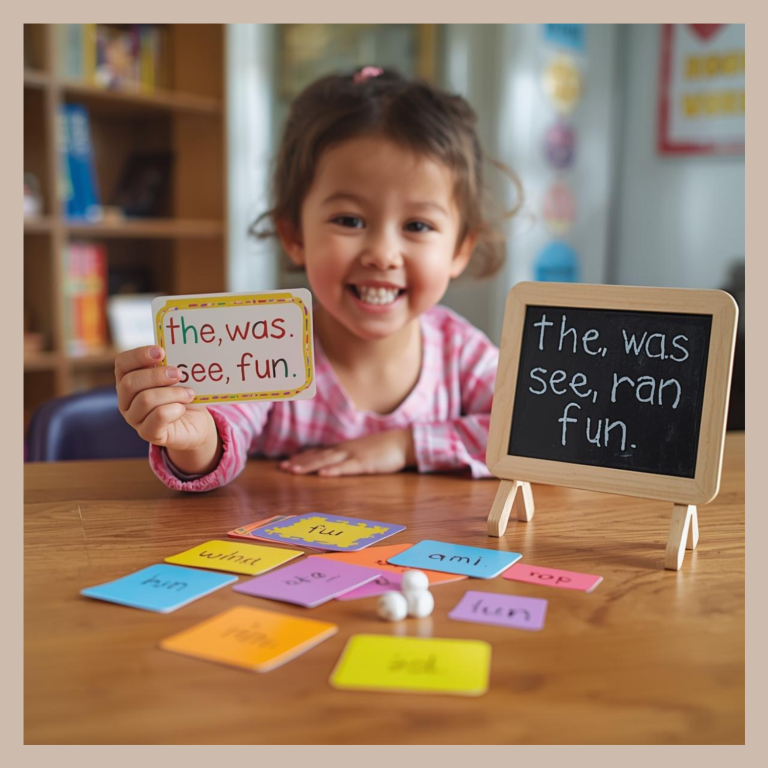
- Create Flashcards: Make simple, clear flashcards for each new word. Introduce one word at a time. Say the word clearly and have your child repeat it.
- Talk About the Word: Point out the letters. “This is the word said. It starts with an s, s-a-i-d.” For non-phonetic words, you can simply explain, “This is a tricky word. We just have to remember what it looks like.”
- Focus on Mastery: Work on one small set of words until your child can recognize them instantly. Once they have mastered the set, you can add a few new words while still reviewing the old ones.
Explore more strategies in Tips for Teaching Sight Words at Home.
Step 2: Make it Multi-Sensory
Children learn best when multiple senses are engaged. Moving beyond just looking at a flashcard helps cement the word in their memory.
- Write in Sand or Shaving Cream: Have your child trace the sight word in a shallow tray filled with sand, salt, or shaving cream while saying the letters and then the word.
- Build with Blocks or Magnets: Use magnetic letters, alphabet blocks, or even play-doh to have your child build the sight words. This hands-on method helps them pay attention to the sequence of letters.
- Air Write: A simple but effective technique is “air writing.” Have your child use their finger to write the word in the air, making the movements large and deliberate.
Get more ideas for sensory learning in Make Sight Words Stick: Engaging Multi-Sensory Techniques.
Step 3: Play Fun and Simple Games
Turning practice into a game is the fastest way to get an enthusiastic learner. Keep activities short (5-10 minutes) to maintain focus and fun.
- Sight Word Go Fish: Create two sets of flashcards for your target words and play a simple game of Go Fish. (“Do you have the word was?”)
- Scavenger Hunt: Write sight words on sticky notes and hide them around a room. Call out a word and have your child race to find it.
- Sight Word Fishing: Attach paper clips to your sight word flashcards and make a simple fishing pole with a stick, string, and a magnet. Let your child “fish” for words and read the ones they catch.
- Sight Word Swat: Lay out a few flashcards on the floor. Call out a word and have your child “swat” the correct card with a fly swatter. This is always a hit!
Step 4: Integrate into Daily Life
The more your child sees these words in context, the more they will stick. Point out sight words everywhere you go.
- During Read-Alouds: As you read a book to your child, occasionally point to a sight word they have been practicing. “Hey, there’s the word you! Can you find another one on this page?”
- In Your Environment: Point out sight words on signs, cereal boxes, or in recipe instructions. This shows them that these words are everywhere and are a real part of reading.
- Write Together: When you write a grocery list or a thank-you note, ask your child to help you write the sight words they know. This reinforces both reading and writing.
You Are Your Child’s Best Teacher
Remember, the goal is progress, not perfection. Every child learns at their own pace. If a particular word isn’t sticking, set it aside and come back to it later. If your child gets frustrated, switch to a different activity. The most important thing is to create a positive and encouraging learning environment.
By combining direct instruction with playful practice, you can help your child build a robust sight word vocabulary. This skill will serve them well, transforming them from a hesitant decoder into a reader who moves through books with confidence and joy.
Happy Homeschooling